What Is Swimming Pool?
Swimming pool construction in Dubai involves structural engineering, waterproofing, mechanical and electrical systems, and coordination with the surrounding landscape, and is one of the more technically demanding elements of any villa project. Concrete pools, built using gunite or shotcrete construction, make up roughly 85 percent of pools built in Dubai, and for good reason: the climate is genuinely punishing on weaker pool structures, with extreme temperature swings, high mineral content in groundwater, and salt-laden coastal air all stressing pool shells over time. Fiberglass and vinyl-liner alternatives are faster to install but offer less design flexibility and, in vinyl’s case, higher lifetime cost due to more frequent replacement.
Pool construction in Dubai requires approval from multiple authorities before ground is broken: Dubai Municipality building permit, DEWA approval for electrical and plumbing connections, and — for villas in managed communities — a No Objection Certificate from the master developer. Communities like Dubai Hills Estate, Arabian Ranches, Emirates Hills, and Palm Jumeirah each have their own community-level guidelines governing pool placement relative to boundary walls, enclosure height, and lighting spill to neighboring plots. Starting construction without these approvals in hand risks fines and forced demolition, which is why a contractor experienced in the specific community’s approval process matters as much as construction skill.
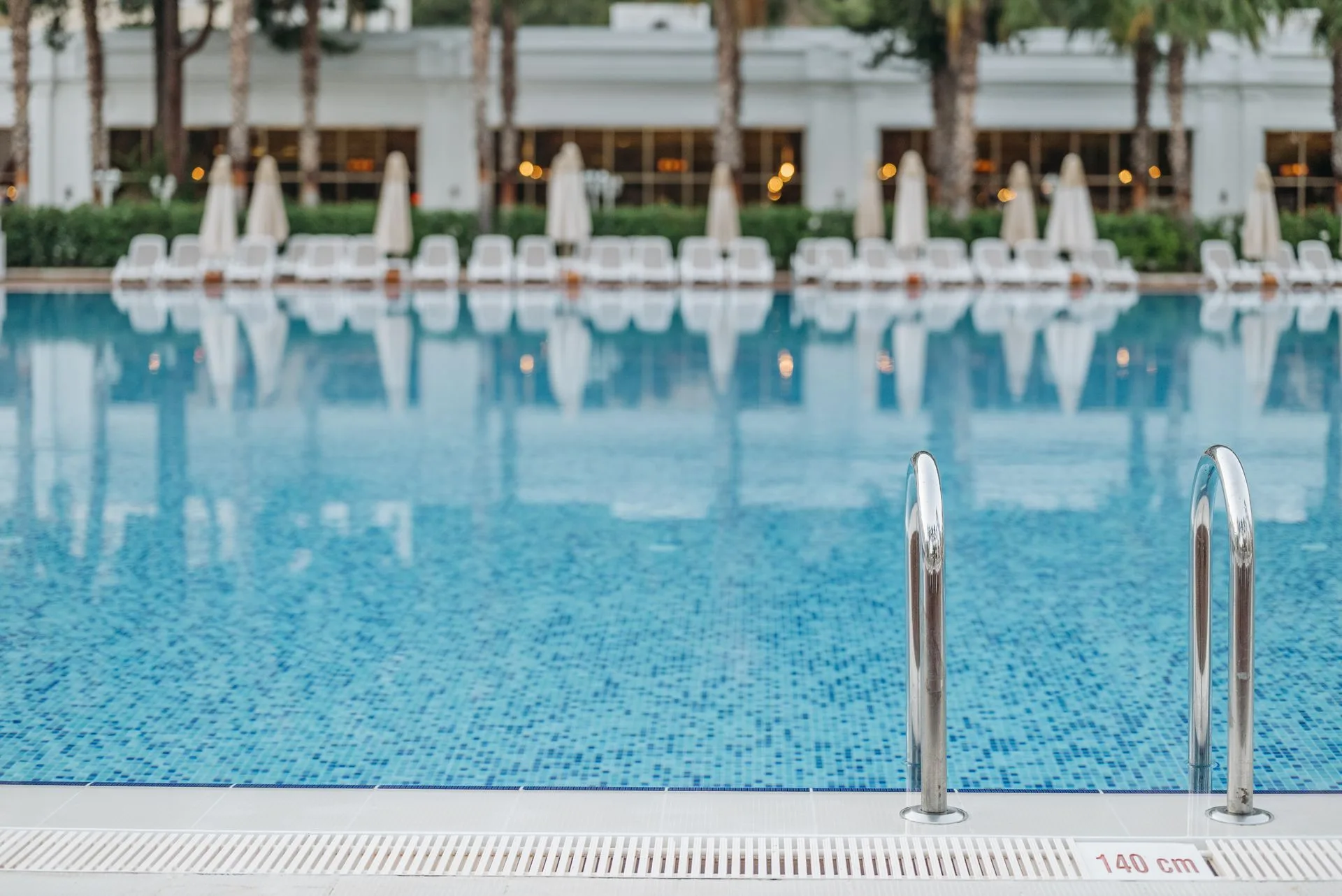
Dubai Municipality’s technical guidelines for pool plan approval set specific safety requirements that shape the design itself: stairs or ladders are mandatory once pool depth exceeds 600mm, at least one ladder is required for every 30 metres of pool circumference, and ladders must be corrosion-resistant with anti-slip surfaces. Beyond 1.4 metres depth, internal stairs are prohibited in favor of side-mounted ladders extending above the pool edge. The surrounding deck must be a continuous, unobstructed walkway at least 1.2 metres wide in non-slip, impervious material, sloped to drain water away from the pool edge. Safety fencing is also a legal requirement for residential pools in Dubai.
Given Dubai’s heat, a cooling or chiller system is effectively essential rather than optional for a residential pool to remain comfortable through summer months, and glass mosaic tile remains the most common finish since it handles UV exposure, the chemical pool environment, and thermal cycling better than most alternatives. A well-designed, well-built pool also consistently adds resale value in Dubai’s market, particularly in premium communities where buyers increasingly expect a pool-ready property.